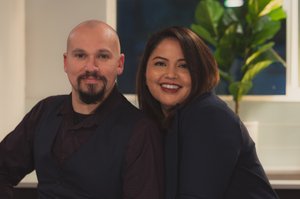
Love Was Never a Feeling. It Was a Choice I Almost Didn’t Make.
For twenty years, I was certain God had abandoned me.
I built that certainty on real evidence, or at least what felt like it at the time. In eighth grade, my oldest brother was murdered. In our own home. I never let myself grieve it. I got angry instead, and that anger didn’t burn out, it just found new places to live: at my family, at the people around me, at God most of all, for two decades straight.
I didn’t know it yet, but that anger walked straight into my marriage with me. And the clearest proof I have that I was wrong about being abandoned starts at a dinner table, a little over ten years ago, where my wife and I sat down to finalize our divorce.
I had already filed the paperwork. I’d already moved out. I had no plan to come back. We couldn’t be in the same room without every unspoken resentment from years of marriage showing up uninvited. So we picked a restaurant, sat across from each other, and got ready to close the book.
Except we never once talked about ending it. We talked about what scared us. What we still wanted out of life, if we were honest. For the first time in years, I was curious about this woman again.
That dinner is where I actually learned the thing I now build my whole career around: love isn’t a feeling. It’s a choice. And I only know that because I’m the guy who almost chose wrong.
The Lie We’re All Being Sold
Culture keeps telling us we’re better off alone: that the right partner is the one who accepts us exactly as we are and never asks us to be uncomfortable. I think that’s one of the more destructive ideas of our generation, and we have the receipts. The Surgeon General has called loneliness a public health epidemic, on par with smoking fifteen cigarettes a day. The number of Americans living completely alone has nearly doubled since 1960. And the marriages people leave to go “find happiness” elsewhere don’t tend to end better, second marriages fail more than first ones, third marriages fail even more, up toward seventy percent. Not because the next person is worse. Because most of us carry our unhealed stuff straight into the next relationship and call it a fresh start.
I know that pull firsthand. I was the guy who filed.
How We Got to That Table
Neither Esme nor I grew up with a marriage worth copying. My house was cold. There wasn’t much love in it. Her childhood was harder than mine. That’s the version of me she met, first week of community college, right after my family moved to Washington. She walked into my English class and the room genuinely slowed down for me. I was loud and awkward about it; she was unimpressed. I can be persuasive, though. We got together. We got married. I loved her, but I was angry and hard to live with, and none of that anger was aimed at her. She just stood in the blast radius of everything I’d never dealt with.
Then her financial aid fell through with a year of school left, and we needed money, so I joined the Army to cover it. I shipped out for close to two years and barely saw her. In my head, I was sacrificing for us. In hers, I had abandoned her. We were both right, and that wound took the better part of a decade to even start closing. By the time I came home, the marriage wasn’t struggling. It was done. Not sad-done. Just done. Years of resentment neither of us had said out loud. So I filed, and I left.
Here’s the part I still can’t fully explain: we couldn’t stand each other, and at the exact same time, Esme was fighting to keep me. Every bit of hurt I brought to that fight, she matched with a refusal to let go that made no logical sense. The only explanation I’ve ever landed on is that God put that fight in her, because if we’d actually gone through with the divorce, it would have pulled us both off a road we were meant to be on. You can’t see that from inside the moment. You can only see it looking back.
The Choice That Was Finally Mine
That fight is what put us at the dinner table that was supposed to end things instead of ending them. A little while after, I got a phone call at work: Esme was pregnant. Every plan I’d built for a life without her collapsed in one sentence.
We met up, and this time the choice was mine to make. She’d been the one choosing me for a long time by then. I was done, and I was still willing, so I put the anger down and picked something bigger than myself. I thought at the time that bigger thing was the baby. It wasn’t. It was years of slow, unglamorous repair. It was choosing to love my wife through long stretches where I honestly didn’t like her.
That’s the choice underneath everything I do now. Love, in practice, doesn’t look like a feeling. It looks like staying at the table when the old version of me would’ve walked out. It looks like doing the dishes for a woman you’re currently annoyed with. It looks like choosing her on a cold day and trusting the warmth comes back on the other side of the choice, because it does. You can’t build a life on something that comes and goes. You build it on a promise: whatever this costs me, I’m going to keep choosing you.
What This Isn’t
I want to be clear about something before I go further, because I know how this can get twisted: I am not telling anyone to stay and suffer no matter what. If you’re in danger, that’s an entirely different conversation, and you need to go. If you’re being held in contempt (made to feel worthless day after day), that’s not a rough patch, that’s harm, and it’s not what this is about. And if your partner flatly refuses to lift a finger, you can’t love someone into a partnership they won’t walk into. That’s not a marriage you’re failing to save; that’s one person choosing themselves over both of you.
This is for the couples where both people are still willing to try. That’s who the rest of this is for.
The Trap in Unconditional Acceptance
If love means choosing your person even on the days you don’t like them, then who you choose matters enormously. And this is where I think culture gets it backwards. We’re told the right partner is the one who takes us exactly as we are and never asks us to change. That sounds loving. It’s actually a trap. A partner who only ever accepts you will leave you exactly as broken as they found you.
What you actually need is both things at once: someone who loves you as you are, and who will also get in your face when you need it, uncomfortably but respectfully. Someone who won’t let you stay small without ever making you feel small. That only works somewhere you can drop the act, and home is supposed to be the one place you finally get to take the mask off.
So here’s the real test of your person: when they say something that lands wrong, can you go back and tell them it hurt, instead of blowing the whole house down? Can you take the mask off and say, this is me, and right now I’m hurting? That safety (to be fully yourself and still get pushed to grow, and to repair it when one of you gets it wrong) is what presence actually buys you.
That kind of repair isn’t a lesson you learn once and move past, though. It’s a muscle you keep having to use, and I got fresh proof of that not long ago.
We’re Still Learning
This past Fourth of July, driving home with the kids in the back seat, Esme and I got into a long conversation about what we each actually want from our marriage, and realized we’d been using the same word, “communication,” to mean two completely different things. The miss was mine. I’d been telling her plainly what I needed, but the way I said it landed as a demand instead of an invitation, and it backed her into a corner. So I changed it. Instead of naming the thing I want, I now tell her the feeling underneath it: that I’m disconnected, that I miss being close to her. That lets her move toward me because she wants to, not because she’s cornered. Fourteen years past that phone call, and we’re still learning how to talk to each other.
That’s exactly why I call this Practicing Presence and not Mastering Presence. You don’t master it. You’re always one bad moment from getting it wrong again. The goal was never perfection. It’s just choosing to keep trying, even after you’ve blown it more times than you can count, even when quitting would be so much easier.
The Pattern I Missed
I said at the start that I spent twenty years sure God had abandoned me. I don’t believe that anymore, not because the feeling changed, but because I finally saw the pattern. Every place my story should have ended, it didn’t. Esme fighting for me when it made no sense. A dinner meant to bury us that brought us back to life instead. I couldn’t see any of it from inside the moment. Only by looking back at the whole shape of it. I think He was carrying me the entire time, and His love worked exactly like the love I’ve spent this whole piece describing: a choice, made over and over, that never once waited for me to deserve it.
A while back, my friend Peter sent me a text I haven’t been able to shake. He said someone had asked God why He allows pain and leads us through darkness, and the answer was: “So you know the way out when I send you back in for someone else.”
That’s what Practicing Presence actually is. It’s me walking back into the worst rooms of my own marriage, on purpose, because I finally know the way out, and going back in to find whoever’s still stuck in there. Every piece I make is a door into one of those rooms. This one’s the front door to all of it.
So if you’re in it right now, if you’re fighting for something worth keeping, tell me in the comments. I want to know I’m not the only one still down here in the dark, still choosing to stay.
I’ll talk to you all soon.